Prompt engineering got us started. Context engineering is what scales.
The teams building the best AI agents have moved past crafting prompts. They're engineering the context that reaches the model: the right information, at the right time. Hebbrix is the infrastructure that makes that automatic.
Hebbrix handles the two ember steps automatically. You own the rest.
The insight that changes how you build AI: the quality of an LLM's output is almost entirely set by the quality of its input. Not the prompt template. Not the model version. The context, meaning the sum of everything the model sees when it generates a response.
Context engineering is the discipline of ensuring your model has exactly the right information at the right time. Not too much, which dilutes attention and fills the window with noise. Not too little, which forces guessing. Precisely the context needed for the task at hand.
Context isn't just the current message. It's the user's history, their preferences, relevant past conversations, related entities, and the institutional knowledge they've shared over months of interaction. Managing all of this manually doesn't scale.
That's where memory infrastructure comes in. Not as a feature bolted onto your agent, but as the core layer that handles context selection, assembly, and ongoing improvement, so your code doesn't have to.
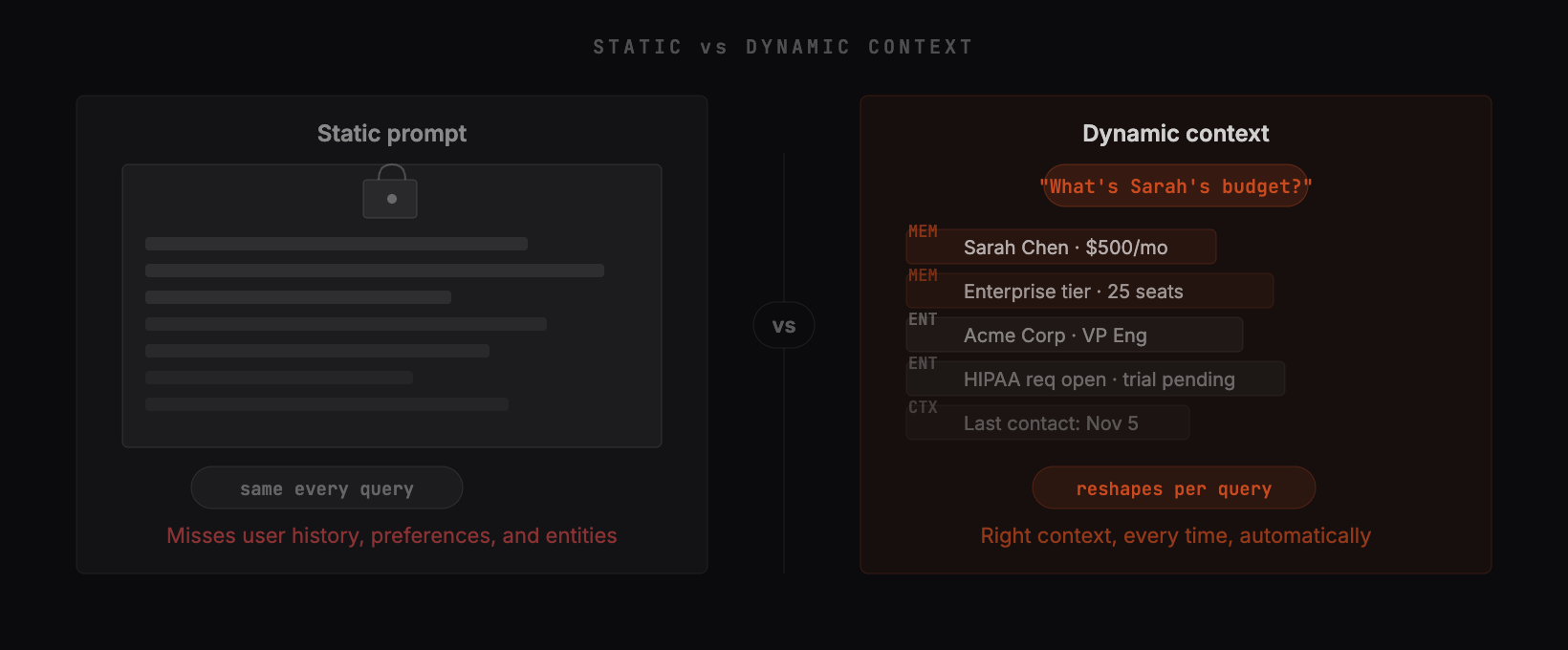
Prompt engineering assumes you can hardcode the right instructions.
Real-world AI applications deal with dynamic context that changes per user, per session, per moment. Four reasons static prompts can't keep up.
Static prompts, dynamic world
A prompt template is the same for every user. But User A is a beginner who needs hand-holding, and User B is an expert who wants concise answers. The prompt doesn't know the difference. Context does.
Context windows are finite
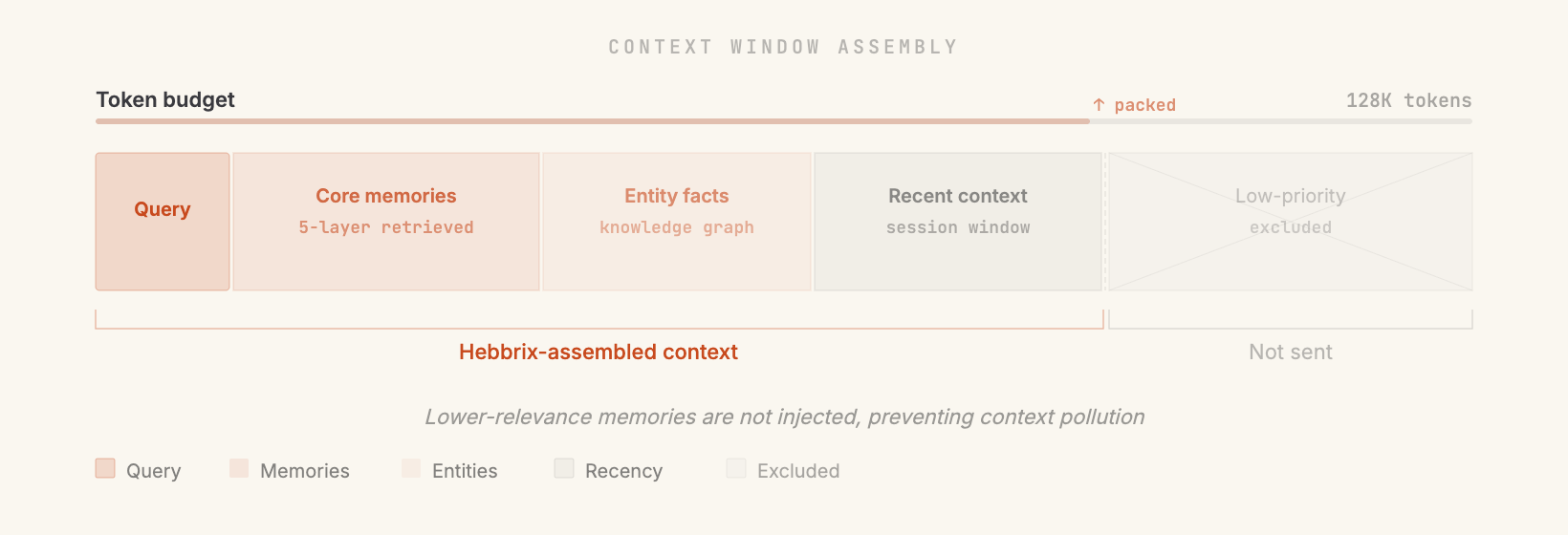
You can't dump everything into the prompt and hope the model figures it out. Token limits are real. What you include, and what you leave out, decides the quality of every response. Context engineering is the discipline of making that choice well.
Relevance changes moment to moment
What's relevant depends on the question being asked right now. A user asking about billing needs billing context, not the feature request they mentioned three weeks ago. Retrieval has to happen at query time, not get picked in advance.
Knowledge needs structure
"Alex reports to Jordan" and "Jordan leads the product team" are two separate facts, but together they imply Alex is on the product team. Structure creates understanding that flat text retrieval can't. Relationships matter as much as facts.
Four components. One automatic system.
Each component solves a specific context engineering challenge. Together they form a complete context infrastructure you never have to hand-roll.
Not all context is equally important. Recent conversation stays sharp. Long-standing preferences persist. The Ebbinghaus forgetting curve governs what decays. Your model sees what matters, not everything that ever happened.
Semantic understanding + keyword precision + knowledge graph traversal + importance + recency. All five signals run in parallel. One sub-second query fills your context window with signal, not noise.
Entities and relationships are extracted automatically from every memory. "Who's on Jordan's team?" returns Alex and Sarah, not because they were mentioned together, but because the graph mapped it. That structure is what makes a response sound like it actually understood the question.
6 quality checks run after every interaction. Memories that helped produce accurate responses get reinforced. Ones that confused or misled fade out. The context your model receives gets cleaner over time, with no manual curation from you.
What changes when you move from prompt templates to context infrastructure
The mental model shift is as important as the technical one.
The whole infrastructure in one endpoint
Hebbrix's chat endpoint is OpenAI-compatible. Send a message and Hebbrix automatically searches relevant memories and injects them as context before forwarding to the LLM. You write zero retrieval logic.
import openai

# Before: prompt template, no memory
# client = openai.OpenAI()

# After: full context engineering infrastructure
client = openai.OpenAI(
    base_url="https://api.hebbrix.com/v1",
    api_key="your_hebbrix_key"
)

# Hebbrix automatically:
# 1. Searches 5 signal layers for relevant context
# 2. Traverses knowledge graph for entity relationships
# 3. Weighs recency + importance to fill context window
# 4. Injects assembled context before forwarding to GPT
# 5. Stores interaction + runs 6 RL quality checks
response = client.chat.completions.create(
    model="gpt-4",
    messages=[{"role": "user", "content": user_message}]
)
Stop engineering prompts. Start engineering context.
Free tier, no credit card. The full context engineering stack in one pip install.